
Ledger · 6 min
Is this card worth grading?
A practical rule for when a raw card should go in a slab: value, expected grade, population, and fees — not vibes.
Updated August 12, 2026 · TCGpal
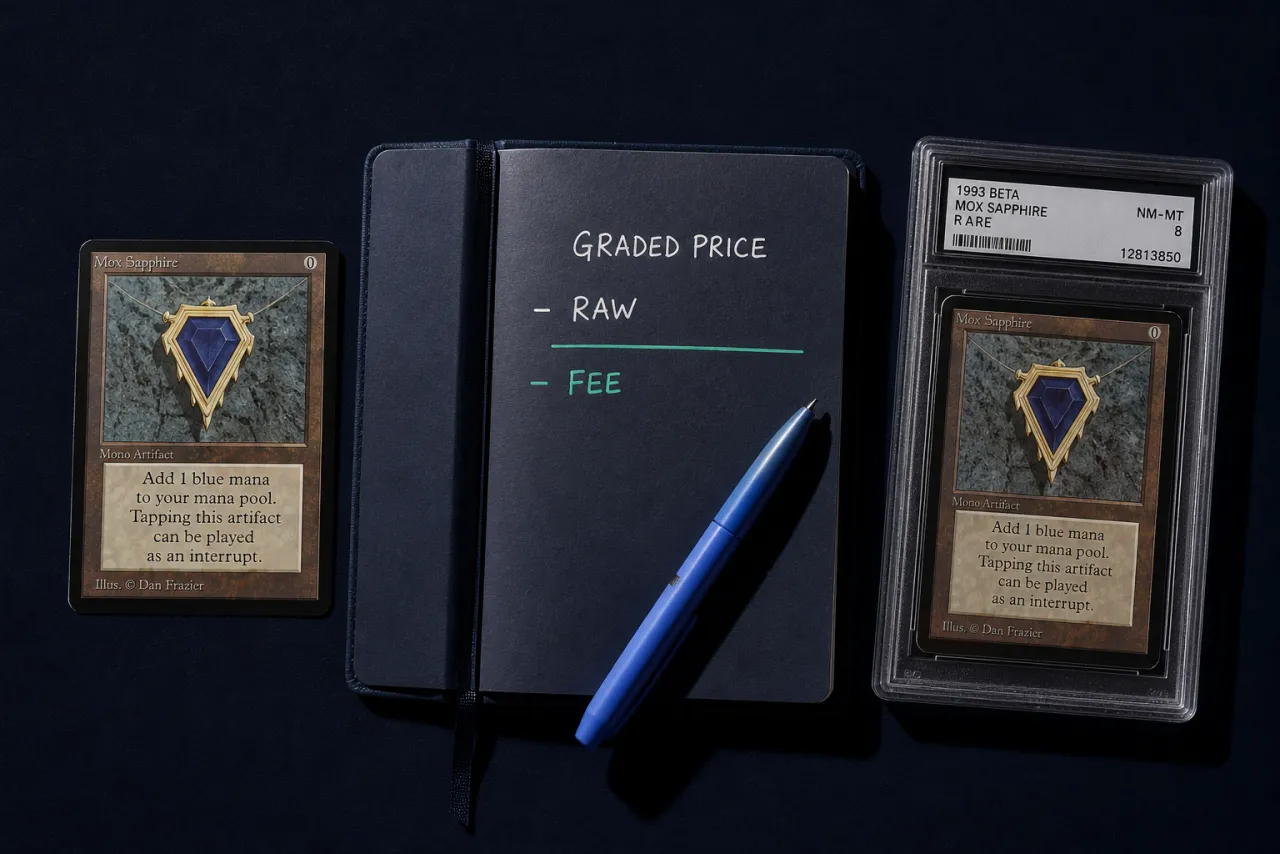
The fee has to clear
Grading costs money and time. A useful rule: the expected graded price minus the raw price minus fees and shipping should still leave a margin you care about. If the card is worth $20 raw, a 10 will not rescue the math on a $25 submission.
TCGpal shows raw versus graded comps next to the pre-grade so that subtraction is not a guess.
Grade it when
The raw card is valuable enough that a 9 or 10 premium covers the fee. The pre-grade is high — especially corners and surface. You want the card protected in a slab for a personal collection, even if you never sell. Population is not already flooded with 10s that sit unsold.
Keep it raw when
The card is under about $20–$30 raw unless it is personally important. Damage is obvious: creases, heavy whitening, dirty surfaces. The pre-grade is a 7 or below on a common card. You would be submitting to “see what happens” — that is how people fund grading companies, not collections.
Population is part of the price
A PSA 10 of a card with 40,000 existing 10s is not scarce. Pop reports and TCGpal’s grading plays exist to show when the graded market is already saturated. A strong pre-grade on a low-pop chase card is a different bet from the same pre-grade on last week’s chase holo.
FAQ
Questions collectors ask
Is there a dollar cutoff for grading?
A useful floor: if the card is under about $20–$30 raw, a 10 rarely covers a modern submission plus shipping unless the card matters to you personally. Above that, do the subtraction with graded comps — there is no magic number that works for every printing.
Should I grade a card I will never sell?
Yes, if you want it protected and you like the slab. That is a collection decision, not a flip. Just do not tell yourself it is an investment when the fee is the point.
The pre-grade is a 9. I think it is a 10. Should I send it?
Retake the photos first, then look at the card under a light. If corners or surface are the 9, believe the limit. Submitting to “see what happens” is how the fee becomes the product.
Does a huge population make grading pointless?
It makes the premium thinner. A PSA 10 with tens of thousands of existing 10s is a commodity. The fee still has to clear a smaller spread. Low-pop chase cards are a different bet — same pre-grade, different math.